Friday, 3 December 2010

Brick

Directed by Rian Johnson in his debut film, Brick (2005) is quite a remarkable experience. It takes the classic noir narrative of crime, but places it on a setting where it really shouldn't work, high school.

In terms of the narrative the film has the classic anti-hero, a detective down on his luck, lonely, alienated, tormented by a woman, desperately trying to find answers and willing to break the law to do it. Another main character is the ever-present in film noir, Femme Fatale, a mysterious and seductive woman who tests our hero's resolve. All the characters of larger than life and uses stereotypes commonly found in the hardboiled novels.

The film is most noticeable for its use of dialog. It takes its dialog style from the old hardboiled detective novels that inspired many of the early 1940's film noirs. It's very odd hearing teenagers talking in this style and the narrative seems like it just shouldn't work at high school but by combining all the different parts that shouldn't work they help complement each other. In other words, while it may seem odd that such young characters have such skewed views of morality, the fact they are in the middle of this detective drama and talking in such a way helps make it more believable and vice-versa.

Visually the films hints at the famous noir style particularly with the opening shot. A dead body is lying in a little stream running out of a menacing dark tunnel. The film also hits at the use of canted camera angles once when our hero Brendan is hit on the head in the tunnel and we see a canted angle shot of a dark shadow running away and whenever our hero it particularly in pain or disorientated, we the audience too become disorientated with the odd angled shots.

A fasinating modern day take on the old hardboiled novels and film noir style Brick is really worth the watch.

Sunset Blvd

Sunset Blvd. (1950) was directed by Billy Wilder who also brought us one of the most famous Film Noir's Double Indemnity. Famous in its time for being one of the first films to show the darker side of Hollywood, Sunset Blvd. boasts four remarkable performances (nominated for all four acting Oscars).

Narratively speaking, the film is quite different from other Film Noirs. While there is a crime involved, (the body of a dead man is found floating in a pool in the opening sequence) the film has very little to do with that. It does us a voice over which is a very common part of the noir films but takes a daring new approach by having the narrator dead from the start.

The film is full of shadows in a very figurative way. It shows the shadowy world deceit and self-deceit, self-loathing and perversion. These are all strong characteristics of Noir narrative. Joe Gillis is the Noir centre of the film not Norma Desmond as it often believed. Norma (Gloria Swanson) is just delusional while Joe (William Holden) is caught in a moral battle of genuine love of another screenwriter and the wealth and pity of Norma.

While the narrative is very shadowy, the visual style is anything but. Visually we have a much more fantastical feel. The grandeur of the house, the many elaborate dresses worn by Norma and the many practical lights help to create the strong feelings of delusion Norma suffers from.

The film does use shadows most commonly when referring to Norma's past, particularly the scene where they are watching her old movies and she stands int the projection light, arm held high with very strong light contrast on her face.

In contrast, whenever Norma is not on the scene the film looks almost normal. However, when Joe is visiting another scriptwriter in the night, secretly and against Norma's wishes the style becomes much darker and much more shadowy. This again helps to back up the point of Joe being the central noir figure.

An unusual noir in both style and content, much can be learned about the themes and styles of noir when viewing Sunset Blvd in comparision to many other film noirs. One thing is for sure though, Sunset Blvd remains just as enticing and fasinating and is truly one of the great movie.

Monday, 22 November 2010

Test Footage 2

Cinematography Test Footage 2 from Michael Barrett on Vimeo.


So here I'm lighting everything using just a desk lamp. The major problem is the ISO was on 800 which caused some very grainy images. More or brighter lights will be needed for shooting.

Night of the Hunter

Directed by Charles Laughton and released in 1955, Night of the Hunter has some of the most memorable and extreme examples of classic noir film shots.

Robert Mitchum's performance in Night of the Hunter is widely regarded as one of his best. The films narrative focuses on a preacher/serial killer seducing a woman to try and get her kids to tell where $10,000 dollars is hidden. Typically of film noir the film does indeed have a bases in crime, but is more in this case to do with greed and focuses much more on the insane and haunting elements of the story.

Very gothic, Night of the Hunter really takes its inspiration from the German expressionism films, taking the noir elements and turning them into a dream-like nightmare. There are a few shots of the film that stand out as among the most powerful in the film. The above image shows a harsh pointed room which really reminds me of a gothic like cathedral. The image left is that of the cellar where the bar like lights really adds to the feeling of being trapped.


The film particularly uses silhouettes throughout the film to shows characters at important moments. Two such moments can be seen in the image to the left and bellow.

The whole of the film has an undertone of the haunting noir like style but the moments that particularly stand out are always the moments where the characters are particularly venerable. They are few but very powerful.

There is no doubt that Night of the Hunter's terrifying performances and haunting images create one of the most atmospheric films I've seen.

Touch of Evil

Directed by Orsen Welles, Touch of Evil was released in 1958 and is widely regarded as the last true Film Noir.
There's no doubt this is a noir. The narrative is your typical crime drama. There's a corrupted police chief, an alienated narcotic detective and his wife and even a sex obsessed motel manager. Betrayal, corruption, murder and revenge are all themes here and common themes of film noir.


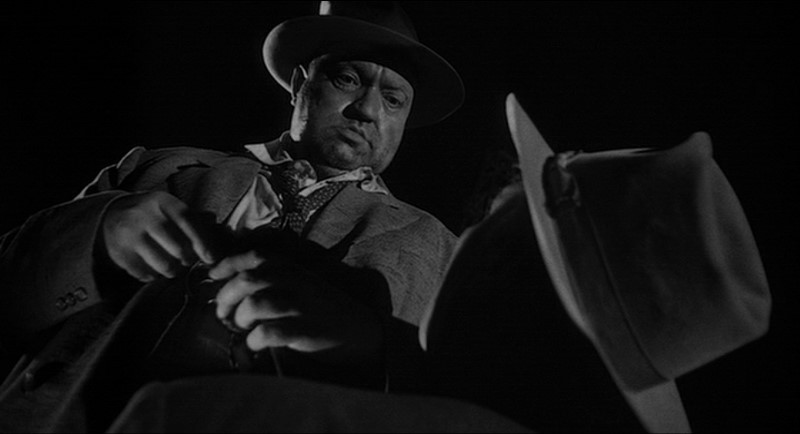
What is particularly interesting about Touch of Evil is its visual noir elements. Many extreme and uncomfortable close ups, particularly of Orsen Welles's character are often used. Also shots at low angles (see picture above), shots with smoke and flashing lights and a shot with a mirror and a person in the back ground appear throughout the film.

Two women feature throughout the film. First off is the detectives wife who although becomes a victim, is to begin with a strong and defiant character. The second is a lady who runs a small bar where our police chief is seen drinking near the end of the film. Here she is working in the dark side of the town and seems to be also a strong woman.

One particular noir element I like which appears in the famous opening long take (a 3 minute long uncut opening take) is a shot where a person holding a bomb runs of screen and a second later his shadow can be seen flying along the wall (this can be seen at 23 seconds in the bellow video). For me this one moment really captures the essence of film noir, a shadow without a person visible connected to it running along a dark alleyway.


All the usual harsh lighting and long shadows appear throughout the film though they only appear at the moments in the narrative when something particularly related to crime happens or is happening. Most clearly this is happening in the long finally where the corrupt police chief is revealing his unlawfulness to a bugged police officer while our hero, the detective, is following and hiding with the receiver. It's all happening at night with long shadows being cast by the street lamps and as the police chief is becoming more worried the camera gets closer and closer to his sweaty face.

Another particularly interesting couple of scenes take place inside the apartment of a possible suspect, then a bar, then back at the apartment. All three scenes are uncut and in the apartment the camera moves throughout three different rooms of the house. While logistically these are interesting scenes what is particularly fascinating is why these scenes where chosen. In the first scene the police chief is clearly quite brutal to the suspect and the detective become aware of this and starts to distrust him. In the bar scene we the audience see how he is not to be trusted and is planning on setting up the detective. Back in the apartment we see how the suspect is then set up so the police chief look good and the detective realises this. Could these be uncut as these three scenes setup the rest of the events in the film therefore are particularly interesting or perhaps Orsen Welles just like long takes. (The two apartment scenes can be seen in the video bellow).

One thing's for sure, Touch of Evil remains a thrilling and gripping film and a great ending to the noir era.

Friday, 12 November 2010

Test Footage

Test Footage from Michael Barrett on Vimeo.

The test footage used a single red head light and sometimes a reflector board. The aim was to create very direct light lighting only certain specific areas.

The first shot used the light shining on a reflector board. This created some strong shadows but proved very hard to get light on a specific area. The camera shot was also a dramatically low angle.

The second shot nicely illuminates the left side of the guys face and there are some nice reflection on the wine bottle.

Shot three used some extra props to block the light and allow the light to only shine on the eyes. However, this was unstable and the light bounces around a great deal.

Shot four was an ECU of the guys eye with the aim of having the light reflected in it. There was a nice light reflection but when we tried to reflect he wine glass it was impossible to see on the camera.

In shot five there were some nice strips of light across the wine glass though it was hard to see the results of the light until it was transferred onto the computer.

Shot six was an attempt to get a dramatic shadow while keeping the first character clear. The biggest difficulty was trying to get the shadow the right size and in the right place.

Shot six was an attempted to get the shadow of the person traveling along ahead of the person. Positioning the light was difficult in the tight location.

The final shot was trying to use a practical light creating a small amount of light.

One thing that's clear is much work testing work needs to be done.


Thursday, 11 November 2010

Cinematography proposal

I will investigate the style of Film Noir through lighting and image composition. I will study the various forms of low-key lighting to create light and dark contrasts, dramatic shadows and highly stylised shots.

I will also evaluate how the use of camera angles in image composition will help explore the themes of film noir. I will particularly look at wide and close-up shots along with dramatic high of low angles and the use of canted shots.

Finally I will test the common cliché's of the genre including that of the Venetian blinds shadow and use of reflections, most commonly in mirrors.

I will see how I can combine all these areas to visualise the themes of disorientation, alienation and the essentially pessimistic tone of the film noir genre.

Films used for inspiration will range from those with a very strong noir look such as Double Indemnity and The Third Man, and those that use a less obvious style such as Sunset Blvd. I will also draw inspiration from modern film examples such as The Man Who Wasn't There and other genres the use noir styles such as Blade Runner.